Recently a letter was sent from International Mission Board headquarters in Richmond to all missionary leaders regarding a paper under review regarding the official position of the IMB regarding women in ministry, women on the mission field, and a woman's subjection to men.
The paper makes official the "complementarian" view of the International Mission Board.
For those of you unfamiliar with the meaning of the word complementarianism, I would encourage you to read this article entitled Complementarianism as a Movement.
Many Christian men and women hold to complementarianism.
However, the problem with the IMB position paper on complementarianism that is now being formulated is the same problem the IMB had ten years ago when I served as a trustee. Back then a group of men took it upon themselves to narrow the doctrinal requirements for serving as a Southern Baptist missionary. They formulated doctrinal papers on spiritual gifts and baptism which stated positions that went far beyond the Baptist Faith and Message. They then demanded applicants agree to the doctrinal positions before serving as a missionary. I objected back then when the issue was forbidding anyone with a "private prayer language" or anyone who was "baptized by immersion in a church that didn't believe in eternal security."
It took ten years but those two poor doctrinal policies were eventually reversed.
Now the issue is complementarianism.
It seems the International Mission Board is moving to prohibit anyone from serving on the field who will not agree that complementarianism is the biblical view of women within the organization structure of the IMB. In the past, women were considered "Team Leaders" as were men. However, in the new complementarian mandate, IMB leadership is going so far as considering removing the title "Team Leader" from any woman, referring instead to her as "the Team Leader's wife."
According to complementarianism, a woman is not to serve in a position of leadership because it would place her in authority "over men." Consistent with that view, it is being proposed that no woman can lead anybody at the IMB in the future. She can only support her man who leads.
What is most serious of all, the paper under formulation is using the eternal subordination of the Son to the Father as the theological basis for the subjection of all women to the authority of men within the International Mission Board. That means, a woman is to be eternally subject to the authority and will of the man, just as Jesus is eternally subject to the authority and will of the Father.
The idea of equality in the Trinity and between men and women is anathema in the complementarian view. Nearly 10 years ago I wrote about the false doctrine of eternal subordination, a view that was gaining traction in the Southern Baptist Convention then.
I never dreamed I would see the day when it would be implemented as back-door policy at the IMB.
Showing posts sorted by relevance for query complementarianism. Sort by date Show all posts
Monday, June 12, 2017
Saturday, June 08, 2019
'Tie an Animal to a Tether and It Will Know the End of the Rope by Morning'- The SBC and Its Women
The "tie an animal to a tether" quote in this blog's title comes from Cotton Mather, but it was used by a strict complementarian pastor last week to justify tethering Christian women so they aren't allowed to lead, instruct, guide, or 'imitate the authority' of a male. To tie a tether to women so they don't "imitate the authority of a male," according to this strict complementarian pastor, is the only way to prevent women from sinning against God for doing things they shouldn't be doing (see his quote at the 1 minute and 25 second mark of this video),
It seems Beth Moore and other gifted SBC women have become dangerously untethered in the eyes of some SBC men.
And now, the issue of what women can and can't do for Christ has sadly risen to the level of Gospel heresy in the minds of some of these SBC complementarians.
The 2019 Southern Baptist Convention convenes in Birmingham, Alabama, Tuesday, June 11, 2019.
The SBC has faced two huge crises this year.
First, the sexual abuse scandal uncovered by the reporters of The Houston Chronicle and San Antonio Express-News showed that many men in the Southern Baptist Convention used their "authority" to sexually prey on victims, and other men "in authority" (pastors) covered for the predators, refusing to involve law enforcement or in some instances, even assist the victims.
Second, and more recently, a social media uproar occurred when some men who deem themselves doctrinally authoritative on all things in the Southern Baptist Convention let it be known that Beth Moore's preaching on "The Lord's Day" (2019 Mother's Day) at an SBC church was a violation of biblical guidelines for women.
According to these men, the Southern Baptist Convention "(has) reached a critical moment...for there are now open calls to retreat from our biblical convictions on complementarianism" (Al Mohler).
Interestingly, complementarianism is a word that is not found in the Bible. That alone doesn't make it false doctrine, but it does cause men like me to scratch my head in wonderment as to how complementarianism can be turned into a Gospel issue.
"Complementarianism is a systematized doctrinal system that promotes the belief that women are eternally subordinate to men in the same manner that Jesus is eternally subordinate to God."
Complementarians believe an unbiblical, illogical, and some say heretical theology of manhood and womanhood. I don't call it heretical because I reserve that word exclusively for Gospel error regarding the Person and work of Jesus Christ, the theme of the Bible.
The roles of women in the church are never Gospel issues.
But some in the SBC (not all) who believe in complementarianism are making their systematized theology on manhood and womanhood a matter of primary importance and a standard of fellowship in the Southern Baptist Convention. They are trifling with subtleties while ignoring certainties.
"But," you may ask, "What do the authoritative Scriptures actually teach about men and women?
- Read Marg Mowczko for a biblical and scholarly understanding of gifted Christian leadership.
- Read Christians for Biblical Equality to find out what the Bible teaches about gender equality.
- Find some scholarly works on biblical equality that are written by those who believe in Scriptural inerrancy and biblical authority.
- Read Fraudulent Authority (shameless self-promotion).
- And most of all, read your Bible.
"The Slave Bible publishers deliberately removed portions of the biblical text, such as the exodus story, that could inspire hope for liberation. Instead, the publishers emphasized portions that justified and fortified the system of slavery that was so vital to the British Empire."It's almost as if some Southern Baptist leaders in 2019 are trying to write and publish a new Bible called The Complementarian Bible.
In this truncated SBC Bible, all references to New Covenant oneness between the genders, all the texts that speak of women teaching or preaching or leading in Christ's Kingdom based on their character and giftedness, and all statements of our Lord Jesus Christ about Christian leaders having "no office of authority, no control over anyone, and being servants to all" (Matthew 20:25-28) have been cut out.
I have no hesitation calling complementarianism unbiblical because it is.
Yet I also have no problem cooperating in the SBC with my complementarian friends for some worthy causes like missions, disaster relief, and other things we do in the SBC.
The Southern Baptist Convention is supposed to be built around Gospel cooperation. Sadly, some men in the SBC are making complementarianism a Gospel issue of cooperation within the SBC.
Tom Ascol, the head of the Founders' Conference, the organization that is sponsoring a rival 2019 SBC Pastors' Conference on manhood, wrote an article the week the SBC sexual abuse story broke in The Houston Chronicle.
Tom's article is entitled Southern Baptists, Sexual Abuse, and a Far More Serious Problem.
Read Tom's article carefully and comprehend what he is saying. I call Tom a friend (so this isn't personal), but what Tom and other complementarians are advocating is dangerous for the SBC. Tom writes:
Southern Baptists must learn to understand and appreciate the differences of biblical interpretation and seek to persuade others we believe to be in error by our charm, intellect, humility, and grace. Never are we called to use any so-called "spiritual authority" over anybody else in the Kingdom.
The demand that others submit to your interpretation of the sacred text is a major problem in the SBC. Jesus is the Chief Shepherd, and His Spirit rules well in the hearts of His people.
Nobody needs tethering except those wishing to tether.
Read Tom's article carefully and comprehend what he is saying. I call Tom a friend (so this isn't personal), but what Tom and other complementarians are advocating is dangerous for the SBC. Tom writes:
1. "The real problem (in the SBC) is spiritual... Southern Baptists have a problem with God... They trumpet their affirmation of the inerrancy of Scripture and unhesitatingly call it the written Word of God...yet they blatantly defy the God of that Word."
2. "How else can we explain the loud trumpeting of Southern Baptists’ commitment to inerrancy while at the same time blatantly refusing to do what the inerrant Scriptures say to do?"
3. "If a pastor is satisfied to neglect clear biblical commands and allow members to go to hell unhindered, it should not surprise us if he looks the other way when they suffer hell on earth at the hands of abusers."Though Tom's article is primarily concerned with a lack of "church discipline" and "regenerative membership," the principles he advocates about 'authority over others" is the basis for his and other complementarians demand for complementarian conformation across the Convention. SBC complementarians think with this logic:
- What we (complementarians) believe about men and women is from God and His inerrant Word.
- If you don't believe or do what we tell you God clearly says about the roles of women in the church and home, then your defiance is against God.
- We are only doing our job as "men with spiritual authority" when we correct you and shun you because of your unbiblical beliefs and practices regarding men and women.
Southern Baptists must learn to understand and appreciate the differences of biblical interpretation and seek to persuade others we believe to be in error by our charm, intellect, humility, and grace. Never are we called to use any so-called "spiritual authority" over anybody else in the Kingdom.
No creed but Christ. No lord but the LORD. No demand for submission by anyone, but delight in service from everyone.You may think you are being biblical, and I do admire your perceived adherence to the authoritative Scriptures, but guys like me are pointing out your serious error of you believing in your own authority rather than Christ's authority.
The demand that others submit to your interpretation of the sacred text is a major problem in the SBC. Jesus is the Chief Shepherd, and His Spirit rules well in the hearts of His people.
Nobody needs tethering except those wishing to tether.
"You shall know the Truth, and He shall set you Free."
We are a Convention of cooperation, not conformity. The SBC should cooperate around who Jesus is and what God has done for sinners.
As mentioned above, the Founders' Ministries has set up what they call a "micro-conference" for SBC pastors this Monday, June 10, 2019, but it is, in reality, a rival Pastors' Conference (the subject is "Mature Manhood in an Immature Age").
I've called them out on this attempt to divide the SBC over the role of women.
Yesterday, Founders published an article entitled "Will the SBC Do The Wade Burleson?"
The major mistake in the article is that they think I'm attacking Tom Ascol, Al Mohler, Owen Strachan, and other complementarians personally.
Nope, I like these men. I'm not even going after their unbiblical principles as much as I am their demands that Southern Baptists acquiesce and submit to their views on complementarianism to be in SBC fellowship or leadership.
I'll not stand by as these SBC men bully Spirit-gifted, Christ-honoring, God-called women who minister in churches and in Christ's Kingdom at large.
The Founders' article closes by asserting Wade Burleson is making false assertions and accusations of good and honorable SBC with "a long track record" of biblical fidelity.
The author calls this "doing the Wade." He challenges the 2019 SBC not to "Do The Wade."
I laughed out loud at that one.
15 years ago I warned the SBC of child abuse in our midst. It's taken 15 years and outside reporters to do what we should have been doing ourselves
For many years I have also been warning the SBC about another major problem in our midst: The tethering of Christian women while at the same time turning differences over gender issues into a Gospel issue.
Both problems in the SBC have the same root: "An unbiblical concept of male authority over others."
I call on all Southern Baptists to not ignore this warning like you did the last one and #DoTheWade
I've called them out on this attempt to divide the SBC over the role of women.
Yesterday, Founders published an article entitled "Will the SBC Do The Wade Burleson?"
The major mistake in the article is that they think I'm attacking Tom Ascol, Al Mohler, Owen Strachan, and other complementarians personally.
Nope, I like these men. I'm not even going after their unbiblical principles as much as I am their demands that Southern Baptists acquiesce and submit to their views on complementarianism to be in SBC fellowship or leadership.
I'll not stand by as these SBC men bully Spirit-gifted, Christ-honoring, God-called women who minister in churches and in Christ's Kingdom at large.
The man tethering a Christian woman to keep her from imitating a male's spiritual authority thinks he's being biblical. The gifted-Christian woman of character who is trying to serve others in churches and the Kingdom while SBC men are attempting to tether her thinks she's being bullied.
| #DoTheWade |
The author calls this "doing the Wade." He challenges the 2019 SBC not to "Do The Wade."
I laughed out loud at that one.
15 years ago I warned the SBC of child abuse in our midst. It's taken 15 years and outside reporters to do what we should have been doing ourselves
For many years I have also been warning the SBC about another major problem in our midst: The tethering of Christian women while at the same time turning differences over gender issues into a Gospel issue.
Both problems in the SBC have the same root: "An unbiblical concept of male authority over others."
I call on all Southern Baptists to not ignore this warning like you did the last one and #DoTheWade
Wednesday, September 05, 2012
The Issue Is Authority: Reasons Why Complementarianism and Feminism Are Fungi Harming the Kingdom
The picture to the left is of a Brazilian ant with a fungus growing on its antennas. National Geographic reports that this new fungus penetrates the brain and eventually kills the ant. According to scientists, this fungus takes over the mind of the ant (I didn't know the ant had a mind), and for this reason, it is called "a mind-control fungus." In this post, I am proposing that there are two fungi that do similar things to people who love Christ and are part of His kingdom. The two fungi in question are complementarianism (patriarchy) and feminism. Let me be clear about what I am saying: The people who are Christian complementarians and Christian feminists are not the fungi--it's what they teach that forms the fungus that is detrimental and ultimately dangerous to the people of God. Complementarianism and feminism have much in common. Let me illustrate.
I like Denny Burk. I don't know him, but I can tell by what he writes that he loves Christ. Yet he, John Piper, Wayne Grudem, and a host of other evangelical men seem to be trying to make the gospel hinge on whether or not Christians believe men should lead women and women should follow men. They remind me of radical Christian feminists. Both groups misunderstand kingdom authority.
Complementarians wish for men to have spiritual authority and for women to not usurp men in their God-given role of authority. Feminism wishes to push women into positions of spiritual authority. The problem with both groups is their unbiblical view of authority. Both groups see ordained clergy, be they priests or pastors, as a separate class of people who possess special positions of authority. To a complementarian and a feminist, words associated with leading others spiritually (words like pastor, shepherd, etc...) are nouns conveying positions of special authority and honorary status instead of verbs characterizing spiritual abilities and humble service. To both groups, the ekklesia has become an instution in need of control rather than a body in need of care.
This dysfunctional view of spiritual authority by complementarians and feminists is the antithesis of the teachings of Christ on the subject. Christ inaugurated a kingdom where nobody seeks a position or title of authority, but where everyone is interested in lovingly serving other people out of one's personal spiritual giftedness and the Holy Spirit's anointing. Jesus specifically taught that leadership in the church flows from selfless service in conjunction with spiritual giftedness (Mark 10:42-43). If a Christian is gifted to teach by God, then he or she should teach. If a Christian is gifted to prophesy, then he or she should prophesy. If a Christian is gifted to lead, then he or she should lead. It honors Christ when a man or a woman understands his or her gifts and uses them for God's glory and the good of others.
Let me give an example. A couple of weeks ago our pastoral staff was preparing to go on a two-day staff retreat. We had a special guest from Dallas Theological Seminary with us the day before we left. She is a Th.M. graduate of Dallas and has the gift of teaching. A couple of hours before we left, I asked this young lady to teach the men on our staff (including me) from the Word of God. She taught from the gospels and chose the passage where Peter saw Jesus walking on water and got out of the boat to go meet Jesus. Her style was inductive and Socratic. Her gift of teaching was evident as she brought us face to face with the fear of failure. We left for our staff retreat and over the next two days, all the guys wanted to talk about were the lessons we learned from our teaching session with this young lady. When we sat down for the Bible study prior to our retreat, the issue for us was not the gender of the teacher, nor the so-called 'authority' (or lack thereof) of the teacher. We were simply being edified by the giftings of a fellow believer as she exercised her spiritual gifts under the anointing of the Holy Spirit.
I recently read where someone wrote: "I cannot understand how anyone can read the Bible and say, “I do not permit a woman to teach or have authority over a man” really means, “I DO permit a woman to teach and have authority over a man.” This person was interpreting Paul's statement in I Timothy 2:15 and coming to the conclusion that any Christian who loves the Bible would never have a woman teach a man or put a woman in leadership 'over' men in the church.
I scratch my head when I read something like the above from Christians who should know better. We have dozens of illustrations in the New Testament of women teaching men (Priscilla, Anna, Philip's four unmarried daughters, and many, many more) and dozens more illustrations from both the Old Testament and the New Testament of women leading men. Those of us who believe the Bible know that Paul would not contradict what has already been established in the kingdom of Christ.
So how do we understand Paul? It's simple. Paul was addressing Timothy about a problem with a specific woman who was teaching error to another man (most likely her husband). Timothy had written to Paul for help, and Paul's response is clear - "I do not permit THAT woman to teach and have authority over a man." There are times when problems in the ekklesia have to be addressed, and Timothy was to address the problem of this woman teaching error. The problem was not that this woman was teaching; the problem was that she was teaching eggregious heresy. Because of the errors being taught by this woman, Paul was concerned for her salvation (I Timothy 2:15). He told Timothy that this woman should be forbidden from teaching. For one of the best textual, exegetical and practical interpretations of I Timothy 2:12-15--an interpretation that is consistent with the rest of the New Testament teaching--I direct you to Cheryl Schatz.
One of these days real revival will come to America. But it will only happen when we repent of our unnecessary and gospel distracting emphasis on gender, as illustrated in both complementarianism and feminism and religious traditionalism. I would encourage all my friends who shepherd God's people to focus more on serving and empowering people to fulfill their calling according to their spiritual gifts and the Spirit's anointing. God forbid we get distracted by the pagan focus on titles and positions of authority.
Friday, June 08, 2018
Complementarianism Is a Good Word that Has Been Hijacked to Wrongly Mean Authoritarianism
I am a person who believes the Bible. Every word of it points me to Jesus Christ. The Bible is our canon (ruler) for life and death, for the Scripture reveals the Truth, and you shall know the Truth, and He shall set you free.
But the Bible is often poorly interpreted.
For example, many modern evangelicals read prophecies in the Bible and wrongly interpret them to be about the "end of the world," and don't realize that these biblical prophecies are vivid, Hebrew apocalyptic writings foretelling the end of Old Covenant Israel (A.D. 70 and the destruction of the Hebrew Temple), and the inauguration of God's New Covenant with the world.
If you confuse the end of the Old Covenant with the destruction of the earth, then your theology and church practices will be more about a coming Kingdom than about the transformative change you can bring to this world by living out the principles of Jesus Christ in this world.
Another example of poor interpretation of God's Word is the belief that God created man in His image, but that "the woman was made for man." Therefore, a woman must always be "under the umbrella of protection" of a man (father, husband, pastor, etc.) for the man has "authority over the woman" like God has authority over His creation.
I'm not making this up. People really believe this to be a biblical concept. Listen to how Southern Baptists on the Council of Biblical Manhood and Womanhood explain this male inherent authority:
Male authoritarianism is antithetical to the teachings of my Savior, the Apostle Paul, and the rest of the New Testament:
Consistent authoritarians like Paige Patterson believe it is an indication of a wicked society when women have positions of authority over men. That belief in male authority is properly called male authoritarianism or patriarchalism.
"But what about I Timothy 2:9-15?" object conservative male Christian leaders.
"But what about the specific prohibition on women in I Timothy 2:15?" object conservative male Christian leaders?
But what about I Corinthians 14:34-35? object other conservative male leaders?"
So I'm a true, biblical complementarian because I accept the teachings of Jesus Christ and reject the false teaching of the inherent authoritarianism of males. Men and women - both genders - complement one another and reveal the full image and character of God.
But the Bible is often poorly interpreted.
For example, many modern evangelicals read prophecies in the Bible and wrongly interpret them to be about the "end of the world," and don't realize that these biblical prophecies are vivid, Hebrew apocalyptic writings foretelling the end of Old Covenant Israel (A.D. 70 and the destruction of the Hebrew Temple), and the inauguration of God's New Covenant with the world.
If you confuse the end of the Old Covenant with the destruction of the earth, then your theology and church practices will be more about a coming Kingdom than about the transformative change you can bring to this world by living out the principles of Jesus Christ in this world.
Another example of poor interpretation of God's Word is the belief that God created man in His image, but that "the woman was made for man." Therefore, a woman must always be "under the umbrella of protection" of a man (father, husband, pastor, etc.) for the man has "authority over the woman" like God has authority over His creation.
I'm not making this up. People really believe this to be a biblical concept. Listen to how Southern Baptists on the Council of Biblical Manhood and Womanhood explain this male inherent authority:
Sin has produced in woman an illegitimate desire to usurp the rightful authority God gave to man (Gen. 3:16), God has worked in Israel and in the Church to establish male-headship as the consistent and approved pattern for religious and home life.This unbiblical and warped view of inherent male authority would be the primary reason I could never join a church or pastor a church where such views were considered biblical. If the leadership of a church believes "only males have authority over people," then that church will be just as dysfunctional as a homosexual marriage. You may like it and be comfortable with it, but you won't give birth to new Kingdom people. You'll grow your church by stealing members from other churches. All-male leadership churches, like nature, aren't designed to procreate.
Male authoritarianism is antithetical to the teachings of my Savior, the Apostle Paul, and the rest of the New Testament:
"The wife does not have authority over .... but yields to her husband. In the same way, the husband does not have authority over ... but yields it to his wife. (I Corinthians 7:4).There is to be a mutual submission between men and women in the Kingdom of Christ (Ephesians 5:21).
Consistent authoritarians like Paige Patterson believe it is an indication of a wicked society when women have positions of authority over men. That belief in male authority is properly called male authoritarianism or patriarchalism.
It's not New Testament. Not even close. Hierarchal patriarchs believe women are permanently subordinate in the family, the church and should be subordinate in culture. Only when God's plan is ignored will a woman ever be in a position of leadership over males.
Those who follow Jesus understand that nobody in Christ's Kingdom - male or female - should grasp authority or seek to rule over anyone. This is a foundational principle that Christ taught.
Complementarianism is a good word. But it's been hijacked by authoritarians.
Complementarianism means:
"The full-orbed image of God cannot be understood without both the male and the female. The two genders complement one another to represent the image of God."
In Scripture, God will often liken Himself to a female, and we are the fruit of His womb.
Why does the Creator do this? Because His image is stamped in both the man and the woman, characteristics of both the father and the mother, and you can't get a full and true sense of God without both sexes.
Therefore, in the home and in the church...
"Men and women bear the image of God and are only limited in Christ's Kingdom, His church, and the Christian family by character, experience, ability, and giftings of the Holy Spirit."Most Christians intuitively know that Jesus Christ empowers His people to serve regardless of gender, but those who wish to restrict women do so based upon just a handful of verses, ignoring the clear teachings of Jesus Christ and the rest of the New Testament.
"But what about I Timothy 2:9-15?" object conservative male Christian leaders.
Answer: Jesus Christ sets women free to serve as He gifts them, and any restrictions of women in the home, church, or society is built on a misinterpretation of this text.
"But what about the specific prohibition on women in I Timothy 2:15?" object conservative male Christian leaders?
Answer: That prohibition is to "the" woman known by both Paul and Timothy and illustrates a specific, pastoral prohibition for a particular church instead of a universal prohibition for all churches.
But what about I Corinthians 14:34-35? object other conservative male leaders?"
Answer: Those two verses are teaching that women SHOULD be teaching and prophesying in the church as they are gifted by the Holy Spirit.
So I'm a true, biblical complementarian because I accept the teachings of Jesus Christ and reject the false teaching of the inherent authoritarianism of males. Men and women - both genders - complement one another and reveal the full image and character of God.
Friday, May 31, 2019
Dr. Mohler, May I Introduce You to Bertha Smith?
![]() |
| Miss Bertha Smith |
He tweeted that there are "open calls (in the SBC) to retreat from our biblical convictions on complementarianism."
In other words, Dr. Mohler seems concerned that women are now in leadership roles around the Southern Baptist Convention, in Southern Baptist churches, and in Southern Baptist entities.
Dr. Mohler tends toward exaggeration for the sake of illustration, just like most of us who speak or write for a living. I'm sure it's unintentional on his part.
But I do like to recount anecdotes to Dr. Mohler from Southern Baptist history to help cure him of his denominational dementia.
So Dr. Mohler, may I introduce you to Olive Bertha Smith? Those of us who knew her or had the privilege of hearing her preach the Word affectionately called her "Miss Bertha."
Al, I would invite you to listen to her preach via the wonder of the Internet at one of our Southern Baptist Churches.
Miss Bertha died in 1988 at the age of 100. Unless you weren't paying attention to Southern Baptist Convention life in the decades before you became President of Southern Seminary (1993), you will surely remember that Miss Bertha preached the Word of God in hundreds of Southern Baptist Convention churches during her lifetime.
Ben Cole messaged me that he has a box of "hundreds of SBC church bulletins where Miss Bertha is the Sunday morning preacher."
But today you tweeted:
"We have reached a critical moment in the Southern Baptist Convention when there are now open calls to retreat from our biblical convictions on complementarianism and embrace the very error that the SBC repudiated over 30 years ago. Honestly, I never thought I would see this day" 11:14 am - 31 May 2019Really, Dr. Mohler?
I realize that some who read your tweet might actually think you are representing a historical fact, and the readers of your tweet might not understand that Twitter is a tool that transforms tomorrow rather than a mirror that accurately reflects the past.
You are as old as I am, and you probably listened to Miss Bertha teach us the Word of God in a church, or from a Southern Baptist Convention platform.
There are some great lessons in our mutually shared SBC history
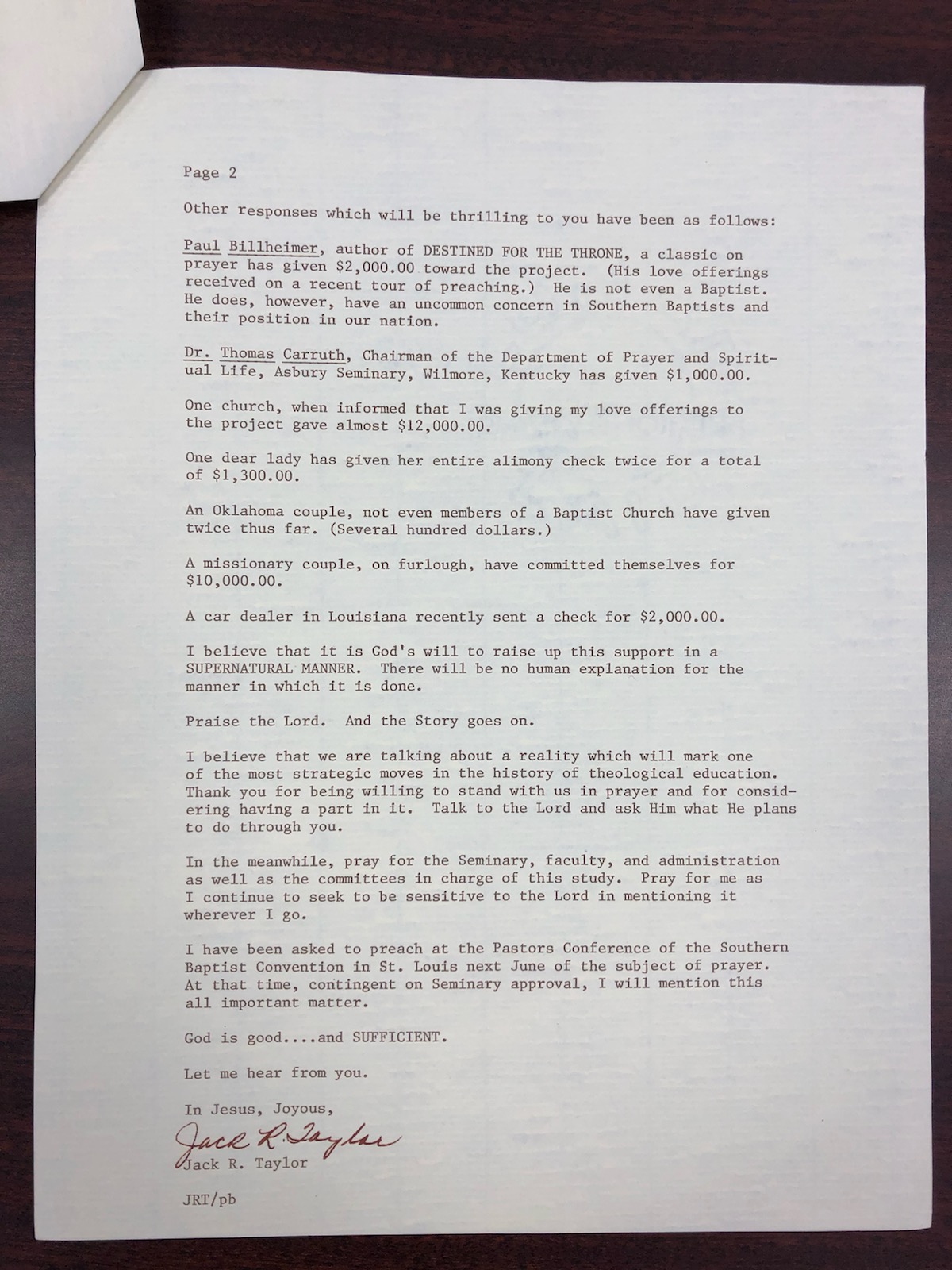
It would be worth your time to read the 1979 letter I've scanned and attached (below). It's written by Southern Baptist evangelist Jack Taylor. He, Dr. Russell Dilday (President of Southwestern Baptist Theological Seminary in 1979), Dr. John Earl Seeling (Vice-President of Southwestern Seminary in 1979), and my father, Paul Burleson (Pastor of Southcliff Baptist Church, Fort Worth, Texas in 1979), as well as dozens of other leading Southern Baptists in 1979 were raising $100,000 to install Miss Bertha on the faculty at Southwestern Baptist Theological Seminary to serve Southern Baptists pastors in a fully endowed Chair of Prayer.
Our Southern Baptist Convention leaders in 1979 wanted Miss Bertha to teach our Southern Baptist preacher boys how to talk with God.
Dr. Mohler, when you say "I never thought I would see this day!" - people like me will take you back to 1979 and
What Beth Moore is doing today in the SBC - teaching men and women in our Southern Baptist Churches on Sunday morning from the platform - has been going on for a very long time in the Southern Baptist Convention.
It takes books, not tweets, to accurately reflect the past 50 years in the Southern Baptist Convention, and a book with a better historical context of the SBC is coming this Christmas.
You and I both believe the Word of God is infallible and inerrant.We've seen this day before.
You and I both believe that Jesus Christ is "the Way, the Truth, and the Life."
You and I just disagree on the history of the SBC.
It's biblical. It's beneficial. It's beautiful.
More to come...
Thursday, October 09, 2008
Semi-Arianism Masquerading as Orthodoxy: A Baptist Scholar on the Trinity Weighs in On "Eternal Subordination"
Contrary to the views of a handful of Baptist Identity bloggers, Southern Baptist blogs can be a source of beneficial debate within the Southern Baptist Convention. Evidence is in the the following email, sent to me after the writer read Growing Semi-Arianism in the SBC The email is from Dr. Curtis Freeman, Director of the Baptist House of Studies, Duke Divinity School, Durham, North Carolina. His words, profound and direct, need no commentary from me.October 8, 2008
Dear Wade:
Thank you for taking up this issue of the Trinity. Getting a Trinitarian conversation going among Baptists is more important than one might first expect given that most Baptists these days are, and for some time have been, functionally Unitarians. For example, in The Baptist Hymnal (1991) out of 666 hymns only 20 are Trinitarian (a ratio of 1:33), but 268 of these 666 hymns are Christological (a ratio of 1:2.5). Baptist worship in the South clearly tilts toward Unitarianism of the Second Person (i.e., a faith in Jesus alone to the near exclusion of the Father and the Spirit), just as on occasions in the past it has leaned in the direction of Unitarianism of the First Person (i.e. a faith in the Father alone with a subordinate role for the Son and the Spirit). To put the matter pointedly, most Baptists are Unitarians that simply have not yet gotten around to denying the Trinity. Non-Trinitarian faith is not necessarily anti-Trinitarian, yet it is reason for concern nonetheless.
All this may seem counter intuitive, but it's true. I often tell incoming students at Duke that they will hear the Trinity invoked more in the first week than in their entire life in Baptist churches. They later surprisingly tell me that they thought I was exaggerating at first, but after a week they came to see that I may have underplayed the way in which our community draws from the life of the Trinity in prayer, worship, study, and living. It has thus become one of my life goals to help the wider Baptist family retrieve a faith and practice grounded in the life of the Triune God in whom we live, and move, and have our very being. To the end that your conversation has served to raise that awareness I am grateful.
However, like you, I am concerned about embracing a Trinitarian doctrine that is not well grounded or tested. For several years now this new doctrine of the eternal subordination of the Son (ESS) has been surfacing among Baptists and other evangelicals. As I've read some of the replies on your blog and other blogs criticizing you, I've encountered the very odd claim that ESS is the historic doctrine of orthodoxy. A simple fact check of the history of the doctrine of the Trinity will reveal that ESS is not a historic doctrine at all, but a very new one. Nor is it part of the received wisdom of the Christian tradition, but in fact is a matter of contemporary speculation. Doctrines do change, and sometimes innovations are received as wisdom. But ESS has yet to be tested and proved by any but a very small and unrepresentative group. The doctrine of the Trinity doesn’t belong to Baptists or Evangelicals. It is the faith shared by all Christians. And until ESS has been tested by the whole Church, it seems prudent to wait.
One of the major concerns about ESS is the supposed distinction between functional and ontological subordination. While it is true that the incarnate Son in his earthly life was submissive to the Father, the suggestion that this subordination extends to his eternal exalted state is worrisome. As Kevin Giles has argued, very persuasively I think, this appears to be a new iteration of Arianism. To be fair to the proponents of ESS, they are not Arians in one important respect: they believe in the Son’s eternal generation (the aspect or Origen’s thought appropriated in the Creed of the Council of Nicaea, “eternally begotten of the Father”), but they also believe in his eternal subordination (the aspect of Origen’s thought not appropriated by the Nicene defenders of homoousios). I suppose that makes them only semi-Arians. [Thanks to my friend and colleague Steve Harmon for this qualification.] The burden of proof, however, is on those proposing this new doctrine of ESS to show that it is not a new form of an old heresy. I’ve yet to be convinced. Until this is worked out it seems wise to wait until this new doctrine of ESS has been thoroughly examined and tested.
Beyond the question of the orthodoxy of ESS, which is still very much in question, I am suspicious of the not so subtle political agenda of ESS which is attracted to Trinitarian theology, not as an account of the life in which we live and move and have our being, but as an argument that underwrites complementarian views. I am just as suspicious of those who use Trinitarian doctrine to support the complementarian social agenda as those who engage in social Trinitarian speculations to underwrite feminist convictions. Miroslav Volf, one of our best Free Church theologians on the Trinity, has called for caution in the use of such speculative Trinitarian theology which can easily be co-opted by ideologies of the right and the left. His cautionary word seems wise regarding ESS. I am suspicious that the real energy behind this new ESS doctrine is really a thinly veiled attempt to elevate complementarianism to de fide orthodoxy, so that complementarian gender relations are set forth as the only acceptable model for Christians and that egalitarianism is heresy equivalent to denying the Trinity. This utilitarian use of Trinitarian doctrine is (in my opinion) based on dubious scholarship and bad theology.
I share the goal of helping our wider Baptist family retrieve the wisdom of the vast storehouse of orthodoxy. As bad as functional Unitarianism is, however, the possible embrace of a semi-Arianism masquerading as orthodoxy used for political ends may be even worse.
Yours in a common faith,
CurtisCurtis W. Freeman
Research Professor of Theology
Director of the Baptist House of Studies
Duke Divinity School
Box 90966
Durham, NC 27708-0966
The one sentence from Dr. Curtis Freeman's email that succinctly states the point I am making about the rise of eternal subordination in the Southern Baptist Convention is this one:
I am suspicious that the real energy behind this new ESS doctrine is really a thinly veiled attempt to elevate complementarianism to de fide orthodoxy, so that complementarian gender relations are set forth as the only acceptable model for Christians and that egalitarianism is heresy equivalent to denying the Trinity.
I shall allow Dr. Al Mohler's own words to frame Dr. Freeman's sentence above:
"The misjudgment of true Fundamentalism is the belief that all disagreements concern first-order doctrines. Thus, third-order issues are raised to a first-order importance, and Christians are wrongly and harmfully divided."Amen, Dr. Mohler. When the "role" of women vs. men is set on an equal plane with the doctrine of the Trinity, then we Christians are wrongly and harmfully divided. May we resist any and all attempts to manipulate our understanding of the Trinity to justify our Biblical understanding of gender.
For further study on the Biblical doctrine of the Trinity, read Dr. Freeman's God in Three Persons: Baptist Unitarianism and the Trinity
In His Grace,
Wade Burleson
Friday, April 18, 2008
And What Is It About Patriarchy That Scares Us?
For the last couple of years I have observed what I perceived to be professional mistreatment of women within the Southern Baptist Convention, all in the name of biblical patriarchy. Though I have no personal disagreement with the 2000 Baptist Faith and Message statement that declares the office of pastor to be reserved for men, I have been puzzled by the removal of female chaplains and other women supervisors on the mission field, the lack of promotion of women to administrative positions in our SBC agencies, and the termination of SBC trained female Hebrew and history professors at our Southern Baptist seminaries. I have truly wondered about the root cause for such actions. What is the philosophical or theological premise that would lead some to exclude women from Southern Baptist positions for which they are either gifted, trained, or eminently qualified to hold?
Cindy Kunsman offered a possible rationale when she spoke at the 2008 Kansas City Evangelical Ministries to New Religions Conference, hosted by Midwestern Theological Seminary. The leaders called this year's conference Biblical Discernment and Apologetics in Missions: The Language of Hope and gave to Cindy Kunsman the opportunity to examine the rise of extreme patriarchal behaviors within groups claiming to be both evangelical and Christian. Her lecture, entitled The Development and Practice for Patriarchy: Cure for Cultural Decline or New Gnostic Disease?, included a pre-approved handout, a power point presentation, and a question answer time which followed.
Cindy is a complementarian herself. She states her personal beliefs on her blog where she writes:
The press release distributed by EMNR reveals the specific complaint against Cindy Kunsman:
Cindy said in her presentation that the Southern Baptist Convention, specifically Russ Moore, Bruce Ware, Paige Patterson, and the Council on Biblical Manhood and Womanhood have influenced the statement of faith, church practices, and strategies of Vision Forum Ministries and her controversial patriarchal pastor and leader Doug Phillips and the emphasis on Family Integrated Churches.
The Lecture That Caused The Controversy
Presenter Cindy Kunsman quoted from Dr. Russell Moore's 2007 lecture at the CBMW sponsored Different By Design Conference where Dr. Moore states complementarians who live like egalitarians are functionally open theists. A similar charge was made by Russell Moore two years earlier at the 2005 Evangelical Theological Society where he added an exhortation for why his listeners should defend patriarchialism: An embrace of biblical patriarchy also protects the doctrine of God from aberrations such as the impersonal deity of Protestant liberalism. Though many Southern Baptists may not fully understand the basis for Professor Moore's statements, the essence of his argument is that the roles of women in society, not just the church, are essential to the gospel itself, and protects against any slide into theological liberalism. As Russ Moore stated in his ETS lecture, for Christians to show the world the gospel it "means specificity in terms of what complementarianism looks like in the present era."
Baptist Press reported in September 2007 on a conference hosted by Southwestern Theological Seminary, where SBC leaders sought to raise awareness of Baptist Identity by emphasizing the gospel through the normative family. The BP reported:
The idea that the gospel is in danger when the 'normative' family is in danger is the same sentiment expressed by the controversial patriarchal pastor, and according to Cindy Kunsman, new Christian cult leader Doug Phillips, who on his Vision Forum Website gives The Tenets of Biblical Patriarchy. Pastor Phillips and Vision Forum were specifically discussed in Cindy's March lecture on 'New Cults' within Christianity, and as such, she quoted Pastor Doug Phillips:
Cindy Kunsman expressed concern in her lecture that anyone would associate 'the gospel' with specific roles that women should play in society and the church. Further, she revealed several of the 'roles,' as envisioned by Doug Phillips, that women must take in order for the gospel to revealed. Some of those mandates for Christian womens' behavior in society and in the church include:
Though a couple of the examples given above may be unfamiliar with most Southern Baptists, the majority could be taken from the headlines of Baptist Press these past ten years.
The Theological Foundation for This New Christian Cult
Again, it must be remembered that Cindy was lecturing this past March on the aberrant views of Doug Phillips, President of Vision Forum, and not the Southern Baptist Convention, whom she at no time in her presentation called aberrant or heretical. Yet, in attempting to find the theological source for the specificities of womens' roles held by Pastor Phillips, Cindy discovered roots in the beliefs and teachings of Civil War Presbyterian theologian R.L. Dabney, Southern Seminary Professor Bruce Ware (the chief theological defender of modern SBC patriarchy), Doug Phillip's friend Paige Patterson, Southern Seminary's Russ Moore, and the Council on Biblical Manhood and Womanhood. It was Southern Baptist theologian Bruce Ware whom Cindy credits with articulating the theological basis for modern patriarchy, and whom she quoted at the conference. She stated objections in her lecture notes to at least three theological views held and taught by Dr. Ware, which she claims has influenced the 'specificities of women's roles' as held by Doug Phillip's Vision Forum Ministries.. (If you are uninterested in the theological basis for Phillip's aberrant views of womens' roles in society, skip to the next section where Doug Phillip's Southern Baptist ties are outlined).
(1). Man is created in the image of God directly, woman indirectly
This theological belief, according to Cindy, causes some patriarchists to believe in 'the priesthood of believers,' but not the priesthood of every believer. Due to man bearing directly the image of God, the husband must be the priest of his wife, and the father of his daughter, for it is the prayers and leadership of the man that 'sanctify' the female. In short, only men, according the logical extension of some who hold to Ware's theology, can be priests unto God. This is why a woman who attempts to pray, teach, lead, or display spiritual authority 'in the presence of men' is forbidden to do so by some patriarchists.
(2). Jesus is eternally subordinate to the Father, and thus, Christians should only pray to, petition, and glorify the Father, for Jesus serves His Father's will, not His own.
Cindy Kunsman stated in her lecture that Ware's belief in the eternal and ontological submission of the Son gives the basis for a woman submitting to the man in all things. Ware affirms only eternal 'funcational subordiation' and not ontological subordination. However, many take the concerpt of 'eternal submission' of Christ as the basis for the woman's submission to, and service for, the male - in speech, conduct, and lifestyle. To the hard-line idealogues who logically extend Ware's theology of the Son's eternal submission, female submission reflects the God of creation and restores creation to its pristine, orginal order, and reverses the curse. This view, according to Cindy, is similar to the views Christians in the south once held regarding 'slavery.' For some Christian leaders in the south, as recently as the 1950's, to give equal status to black people was thought to be contrary to the nature of God. As abolitionists were once called 'liberal,' so too, those Christians who promote the equality of women today are called 'liberal' because they threaten to undo the very nature of God. Thus, in Doug Phillips mind, anyone who does not follow his very specific rules for women (no birth control, modest dress, stay at home mom, no higher education, homeschooling kids, etc . . .) is undermining the very character of God.
(3). Jesus is not equal to the Father in authority. He never was nor ever will be. He comes from the Father, as the woman from the man, and is subordinate to the Father, as the woman is to the man.
Cindy believes this view may contradict historic Christianity and Scripture itself. Jesus said, "Whatever you ask in My name, that will I do, so that the Father may be glorified in the Son" (John 14:13), and "If you ask Me anything in My name, I will do it" (John 14:14) which indicates there is no ontological, or eternal functional subordination to the Father.
Doug Phillips Ties to the Southern Baptist Convention
Doug's father, Howard Phillips, served in the Nixon Administration and was a director for The Council on National Policy. Serving with Howard in 1996 on the Council for National Policy were his son Doug, Southern Baptists Paige Patterson, Judge Paul Pressler, Judge Roy Moore, and others.
Remember that Cindy was speaking on a conference about new cults arising within Christianity, and specifically she expressed her concern with the direction of Vision Forum. Her premise was that Doug Phillips and Vision Forum have been heavily influenced theologically by a few Southern Baptists, but "the specificity in terms of what complementarianism looks like in the present era" (as Russell Moore calls it) were Vision Forums specificities and not necessarily the Southern Baptist Convention's.
Or are they?
Dorothy Patterson commends Doug Phillips book Passionate Housewives Desparate for God where women are called to stay home and not work. Doug Phillips himself speaks admiringly of Paige Patterson and the conference platform he shared with Dr. Patterson in May 2003, where the two men discussed the godliness of boys hunting, going to war, and women staying home to serve the men and children.
As Doug Philliips honors two women in his Wednesday, June 23, 2004 blog who abstained from birth control and gave birth to a total of 40 children, so too Dorothy Patterson writes on her own blog that abstinence from any artificial birth control is 'God's Plan' for women.
We could go on about Doug Phillips belief that women should not pursue graduate degrees for career purposes (but can pursue homemaking degrees such as those offered at SWBTS), and the belief that a woman must be absolutely silent regarding spiritual matters in the presence of men, and the unique 19th century dresses, hats and other modest clothing that women and girls are encouraged to wear (see here, here, and here) . . . but you get the drift.
Conclusion
Cindy Kunsman lives just outside Detroit. Her husband, Gary Kunsmen, Phd. is the chief forensic toxologist at the Oakland County Medical Examiner's Office. Cindy and Gary have been members of two churches that mistreated women because of extreme patriarchal views of the leaders within those churches. As stated, Cindy is a traditional complementarian but is concerned with a new brand of patriarchalism that is subjugating women in ways not seen since the 1700's. A friend of Cindy's has coined the word "Patriocentricity" to define this new movement. Cindy is concerned enough to research the subject, present her views on it, and at least discuss the issues with those who disagree.
She's not used to people reacting the way they did after her talk at Midwestern. I have two questions for those who have accused Cindy of Southern Baptists and their influence on the patriarchal movement across evangelicalism, specifically through leaders of Southern and Southwestern Seminaries. (1). Does the demand for a retraction from Cindy mean that some folks at these agencies within the Southern Baptist Convention are now seeing the potential dangers of a resurging patriarchal movement within evangelical circles? and, (2). Since when is an 'Academic Conference,' as was the EMNR Conference in March 2008 hosted by Midwestern Theological Seminary, subject to censorship? Would it not be more appropriate for a response to be given to Mrs. Kunsman's lecture than to act like it never happened?
Finally, if there are those who question how a solid, evangelical Southern Baptist theologian like Dr. Bruce Ware, or other Southern Baptists could ever be spoken of in the same breath as Doug Phillips and Vision Forum, let this be a lesson that just because someone articulates truths that may be taken and misused in 'specificities' does not necessarily mean the articulation of those theological views is necessarily wrong. In other words, just as complementarianism and Christian patriarchy do not automatically mean 'cultic,' neither does egalitarianism and equality necessarily always mean 'liberal.' On the other hand, we should always be on guard that we don't allow drifting toward extremism in any one particilar doctrine. Christians sometimes really do go off on tangents - both right and left.
In His Grace,
Wade Burleson
Cindy Kunsman offered a possible rationale when she spoke at the 2008 Kansas City Evangelical Ministries to New Religions Conference, hosted by Midwestern Theological Seminary. The leaders called this year's conference Biblical Discernment and Apologetics in Missions: The Language of Hope and gave to Cindy Kunsman the opportunity to examine the rise of extreme patriarchal behaviors within groups claiming to be both evangelical and Christian. Her lecture, entitled The Development and Practice for Patriarchy: Cure for Cultural Decline or New Gnostic Disease?, included a pre-approved handout, a power point presentation, and a question answer time which followed.
Cindy is a complementarian herself. She states her personal beliefs on her blog where she writes:
Personally, I hold to a traditional, complementarian view wherein women . . . do not meet Biblical qualifications to be senior pastors or elders . . . but they certainly can minister as a members of pastoral staff(s).The above statement is consistent with the 2000 Baptist Faith and Message. However, it is what Cindy said about the views of Southern Seminary's Dean of Theology Russel Moore, highly esteemed theologian and Southern Seminary professor Bruce Ware, The Council on Manhood and Womanhood and Paige Patterson that caused any reference to her presentation to be removed from the EMNR's website, a change in Executive Director leadership at EMNR, and a demand for disclaimers and retractions from Cindy.
The press release distributed by EMNR reveals the specific complaint against Cindy Kunsman:
Several people have contacted us regarding a presentation on "Christian Patriarchy" by Cynthia Kunsman at EMNRʼs national conference, held at Midwestern Baptist Theological Seminary in March 2008. After reviewing her presentation, the board of EMNR and the administration of Midwestern Baptist Theological Seminary concur that Mrs. Kunsman made unwarranted and misinformed accusations against Christian teachers and ministries, including the Council on Biblical Manhood and Womanhood and agencies within the Southern Baptist Convention. While several aspects of the "Christian Patriarchy" movement (exemplified by Vision Forum) merit study and correction, in this instance the speakerʼs criticism of alleged "influences" on this movement was faulty.
Cindy said in her presentation that the Southern Baptist Convention, specifically Russ Moore, Bruce Ware, Paige Patterson, and the Council on Biblical Manhood and Womanhood have influenced the statement of faith, church practices, and strategies of Vision Forum Ministries and her controversial patriarchal pastor and leader Doug Phillips and the emphasis on Family Integrated Churches.
The Lecture That Caused The Controversy
Presenter Cindy Kunsman quoted from Dr. Russell Moore's 2007 lecture at the CBMW sponsored Different By Design Conference where Dr. Moore states complementarians who live like egalitarians are functionally open theists. A similar charge was made by Russell Moore two years earlier at the 2005 Evangelical Theological Society where he added an exhortation for why his listeners should defend patriarchialism: An embrace of biblical patriarchy also protects the doctrine of God from aberrations such as the impersonal deity of Protestant liberalism. Though many Southern Baptists may not fully understand the basis for Professor Moore's statements, the essence of his argument is that the roles of women in society, not just the church, are essential to the gospel itself, and protects against any slide into theological liberalism. As Russ Moore stated in his ETS lecture, for Christians to show the world the gospel it "means specificity in terms of what complementarianism looks like in the present era."
Baptist Press reported in September 2007 on a conference hosted by Southwestern Theological Seminary, where SBC leaders sought to raise awareness of Baptist Identity by emphasizing the gospel through the normative family. The BP reported:
When the church's view of the family is awry, the Gospel is being falsely presented, theologian Russell Moore said during Southwestern Baptist Theological Seminary's third annual Baptist Distinctives Conference.
Also speaking on this year's theme -- "The Family: Reclaiming a Biblical View of the Family, Womanhood and Manhood" -- were Southwestern President Paige Patterson and Dorothy Patterson, professor of theology in women's studies; Richard Land, president of the Southern Baptist Ethics & Religious Liberty Commission; Mark Liederbach, associate professor of Christian ethics at Southeastern Baptist Theological Seminary; and Tom Elliff, senior vice president of spiritual nurture and growth for the International Mission Board.
The family is a "Gospel issue," Moore said in his presentation, titled "Have Baptists Changed or Has Culture?: The Baptist View of the Family
The idea that the gospel is in danger when the 'normative' family is in danger is the same sentiment expressed by the controversial patriarchal pastor, and according to Cindy Kunsman, new Christian cult leader Doug Phillips, who on his Vision Forum Website gives The Tenets of Biblical Patriarchy. Pastor Phillips and Vision Forum were specifically discussed in Cindy's March lecture on 'New Cults' within Christianity, and as such, she quoted Pastor Doug Phillips:
The church should proclaim the Gospel centered doctrine of biblical patriarchy as an essential element of God’s ordained pattern for human relationships and institutions.
Cindy Kunsman expressed concern in her lecture that anyone would associate 'the gospel' with specific roles that women should play in society and the church. Further, she revealed several of the 'roles,' as envisioned by Doug Phillips, that women must take in order for the gospel to revealed. Some of those mandates for Christian womens' behavior in society and in the church include:
(1). Women are called by God to serve their patriarchs (fathers) until married when they will then serve their husbands.
(2). Women are not to speak in a church setting, but are to ask their husbands any questions they may have and remain silent in the presence of men.
(3). Women are not to work outside the home for any income, but are to be housewives and homemakers within the home.
(4). Women are never to teach a man anything, but are to learn from men in a quiet and submissive spirit.
(5). Women cannot have communion unless given to them by their husband or, in the case of an absent husband, an elder from a 'normative' family or, in rare cases, a mother can be served be her son if he (the son) is old enough to walk and carry the host and is present in worship with her.
(6). Women are to cover their heads as a sign of their 'submission' to their husbands and to God.
(7). Women are not to attend a university or any institution of higher learning for the purpose of pursuing a career.
(8). Women are not to vote, but are to let their husbands speak for them.
(9). Women are never, for any reason, to use birth control.
(10) Women are to respond to abuse in a quiet, gentle and submissive spirit.
Though a couple of the examples given above may be unfamiliar with most Southern Baptists, the majority could be taken from the headlines of Baptist Press these past ten years.
The Theological Foundation for This New Christian Cult
Again, it must be remembered that Cindy was lecturing this past March on the aberrant views of Doug Phillips, President of Vision Forum, and not the Southern Baptist Convention, whom she at no time in her presentation called aberrant or heretical. Yet, in attempting to find the theological source for the specificities of womens' roles held by Pastor Phillips, Cindy discovered roots in the beliefs and teachings of Civil War Presbyterian theologian R.L. Dabney, Southern Seminary Professor Bruce Ware (the chief theological defender of modern SBC patriarchy), Doug Phillip's friend Paige Patterson, Southern Seminary's Russ Moore, and the Council on Biblical Manhood and Womanhood. It was Southern Baptist theologian Bruce Ware whom Cindy credits with articulating the theological basis for modern patriarchy, and whom she quoted at the conference. She stated objections in her lecture notes to at least three theological views held and taught by Dr. Ware, which she claims has influenced the 'specificities of women's roles' as held by Doug Phillip's Vision Forum Ministries.. (If you are uninterested in the theological basis for Phillip's aberrant views of womens' roles in society, skip to the next section where Doug Phillip's Southern Baptist ties are outlined).
(1). Man is created in the image of God directly, woman indirectly
"Man is the image of God directly, woman is the image of God only through the man… Because man was created by God in His image first, man alone was created in a direct and unmediated fashion as the image of God, manifesting then the glory of God in man, that is male man… If male headship is rooted in the image of God itself, then it isn’t just a functional distinction of how we work out. It really does mean we are made in a different way.It may be best to understand the original creation of male and female as one in which the male was made in the image of God in a direct, unmediated and unilateral fashion, while the female was made image of God through the man and hence in a indirect, mediated and derivative fashion. So while they are both fully image of God, there is also a God intended priority given to the man as the original image of God through whom the woman, as image of God, derived from the male comes to be… Identity is rooted in priority given to the male… Her identity as female is inextricably tied to and rooted in the identity of the male… Her created glory is a reflection of the man’s… has her glory through the man. Seth is the image of God because he was born through the fatherhood of Adam. Specifically Adam is mentioned and not Eve. As Seth is born in the likeness and image of Adam, so is he born in the likeness and image of God. Male headship is a part of the very constitution of woman." Bruce Ware in his lecture Building Strong Families in Your Church
This theological belief, according to Cindy, causes some patriarchists to believe in 'the priesthood of believers,' but not the priesthood of every believer. Due to man bearing directly the image of God, the husband must be the priest of his wife, and the father of his daughter, for it is the prayers and leadership of the man that 'sanctify' the female. In short, only men, according the logical extension of some who hold to Ware's theology, can be priests unto God. This is why a woman who attempts to pray, teach, lead, or display spiritual authority 'in the presence of men' is forbidden to do so by some patriarchists.
(2). Jesus is eternally subordinate to the Father, and thus, Christians should only pray to, petition, and glorify the Father, for Jesus serves His Father's will, not His own.
The Son stands in a relationship of eternal submission under the authority of His Father… We’ll see and marvel at the fact that while the Father and Son are in a relationship marked by eternal authority and submission. We’ll see, in short, that the Son in fact is the eternal Son of the eternal Father, and hence, the Son stands in a relationship of eternal submission under the authority of His Father . . . What do we learn from this first account,? First, the very same Jesus who claims implicitly to be God (John 8:23) then proceeds to describe himself as doing nothing by his own authority speaking only what the Father teaches him, and in doing only and always what pleases the Father (vv 28-29)… As eternally divine and not of this world, he is God the Son, but as under the authority of his Father, and as the eternal Son of the Father, he is God the Son." (Pages 71, 74) Bruce Ware in his book From Father, Son and Holy Spirit: Relationships, Roles and Relevance
Cindy Kunsman stated in her lecture that Ware's belief in the eternal and ontological submission of the Son gives the basis for a woman submitting to the man in all things. Ware affirms only eternal 'funcational subordiation' and not ontological subordination. However, many take the concerpt of 'eternal submission' of Christ as the basis for the woman's submission to, and service for, the male - in speech, conduct, and lifestyle. To the hard-line idealogues who logically extend Ware's theology of the Son's eternal submission, female submission reflects the God of creation and restores creation to its pristine, orginal order, and reverses the curse. This view, according to Cindy, is similar to the views Christians in the south once held regarding 'slavery.' For some Christian leaders in the south, as recently as the 1950's, to give equal status to black people was thought to be contrary to the nature of God. As abolitionists were once called 'liberal,' so too, those Christians who promote the equality of women today are called 'liberal' because they threaten to undo the very nature of God. Thus, in Doug Phillips mind, anyone who does not follow his very specific rules for women (no birth control, modest dress, stay at home mom, no higher education, homeschooling kids, etc . . .) is undermining the very character of God.
(3). Jesus is not equal to the Father in authority. He never was nor ever will be. He comes from the Father, as the woman from the man, and is subordinate to the Father, as the woman is to the man.
"The Western church adapted the Nicene Creed to say, in its third article, that the Holy Spirit proceeds from the Father “and the son” (filioque) and not merely that he proceeds from the Father (alone). While I agree fully with this additional language, I believe that this biblical way of speaking, as found in John 15:26, (But when that Comforter shall come, whom I will send unto you from the Father, even the Spirit of truth, which proceedeth of the Father, he shall testify of me.), refers to the historical sending of the Spirit at Pentecost and does not refer to any supposed “eternal procession” of the Spirit from the Father and the Son. The conceptions of both the “eternal begetting of the Son” and “eternal procession of the Spirit” seem to me highly speculative and not grounded in biblical teaching. Both the Son as only-begotten and the Spirit as proceeding from the Father (and the Son) refer, in my judgment, to the historical realities of the incarnation and Pentecost respectfully.” Footnote 3 on Page 162, from Ware's book From Father, Son and Holy Spirit: Relationships, Roles and Relevance
Cindy believes this view may contradict historic Christianity and Scripture itself. Jesus said, "Whatever you ask in My name, that will I do, so that the Father may be glorified in the Son" (John 14:13), and "If you ask Me anything in My name, I will do it" (John 14:14) which indicates there is no ontological, or eternal functional subordination to the Father.
Doug Phillips Ties to the Southern Baptist Convention
Doug's father, Howard Phillips, served in the Nixon Administration and was a director for The Council on National Policy. Serving with Howard in 1996 on the Council for National Policy were his son Doug, Southern Baptists Paige Patterson, Judge Paul Pressler, Judge Roy Moore, and others.
Remember that Cindy was speaking on a conference about new cults arising within Christianity, and specifically she expressed her concern with the direction of Vision Forum. Her premise was that Doug Phillips and Vision Forum have been heavily influenced theologically by a few Southern Baptists, but "the specificity in terms of what complementarianism looks like in the present era" (as Russell Moore calls it) were Vision Forums specificities and not necessarily the Southern Baptist Convention's.
Or are they?
Dorothy Patterson commends Doug Phillips book Passionate Housewives Desparate for God where women are called to stay home and not work. Doug Phillips himself speaks admiringly of Paige Patterson and the conference platform he shared with Dr. Patterson in May 2003, where the two men discussed the godliness of boys hunting, going to war, and women staying home to serve the men and children.
As Doug Philliips honors two women in his Wednesday, June 23, 2004 blog who abstained from birth control and gave birth to a total of 40 children, so too Dorothy Patterson writes on her own blog that abstinence from any artificial birth control is 'God's Plan' for women.
We could go on about Doug Phillips belief that women should not pursue graduate degrees for career purposes (but can pursue homemaking degrees such as those offered at SWBTS), and the belief that a woman must be absolutely silent regarding spiritual matters in the presence of men, and the unique 19th century dresses, hats and other modest clothing that women and girls are encouraged to wear (see here, here, and here) . . . but you get the drift.
Conclusion
Cindy Kunsman lives just outside Detroit. Her husband, Gary Kunsmen, Phd. is the chief forensic toxologist at the Oakland County Medical Examiner's Office. Cindy and Gary have been members of two churches that mistreated women because of extreme patriarchal views of the leaders within those churches. As stated, Cindy is a traditional complementarian but is concerned with a new brand of patriarchalism that is subjugating women in ways not seen since the 1700's. A friend of Cindy's has coined the word "Patriocentricity" to define this new movement. Cindy is concerned enough to research the subject, present her views on it, and at least discuss the issues with those who disagree.
She's not used to people reacting the way they did after her talk at Midwestern. I have two questions for those who have accused Cindy of Southern Baptists and their influence on the patriarchal movement across evangelicalism, specifically through leaders of Southern and Southwestern Seminaries. (1). Does the demand for a retraction from Cindy mean that some folks at these agencies within the Southern Baptist Convention are now seeing the potential dangers of a resurging patriarchal movement within evangelical circles? and, (2). Since when is an 'Academic Conference,' as was the EMNR Conference in March 2008 hosted by Midwestern Theological Seminary, subject to censorship? Would it not be more appropriate for a response to be given to Mrs. Kunsman's lecture than to act like it never happened?
Finally, if there are those who question how a solid, evangelical Southern Baptist theologian like Dr. Bruce Ware, or other Southern Baptists could ever be spoken of in the same breath as Doug Phillips and Vision Forum, let this be a lesson that just because someone articulates truths that may be taken and misused in 'specificities' does not necessarily mean the articulation of those theological views is necessarily wrong. In other words, just as complementarianism and Christian patriarchy do not automatically mean 'cultic,' neither does egalitarianism and equality necessarily always mean 'liberal.' On the other hand, we should always be on guard that we don't allow drifting toward extremism in any one particilar doctrine. Christians sometimes really do go off on tangents - both right and left.
In His Grace,
Wade Burleson
Saturday, August 18, 2012
It Honors Christ and Is Biblical for Women to Teach Men
"And there was a prophet named Anna ... a widow of eighty-four. She never left the temple, serving night and day ... and she continued to ἐλάλει of Him to all those who were looking for the redemption of Jerusalem" (Luke 2:36-38 NAS).
I have used the Greek verb ἐλάλει in quoting the text above without translation. Before I show you how this word is used throughout the New Testament, let me remind you of a few things to set the context of this very important text. I believe the Bible is the inspired and infallible Word of God, and our beliefs and behavior should reflect the biblical standard.
(1). The gospel writer Luke is describing the first public appearance of Jesus Christ (the Anointed One) in the Temple of Jerusalem.
(2). The law of first mention makes this verse vitally important in showing how Christ is to be revealed to people.
(3). Simeon has already preached a stirring proclamation of Christ to all (see Luke 2:34-36).
(4). Anna now takes center stage and ἐλάλει of Christ to all.
The word ἐλάλει is used throughout the New Testament. This word is used of Jesus in Mark 2:2 where he "preached the word" (KJV) in Capernaum. This word is translated "stating the matter plainly" in Mark 8:32 (NAS). It is most often used of Jesus when he "speaks" to His disciples for the purpose of instruction. This word conveys in its etymology and essence: "To speak for the purpose of teaching."
Anna taught the people of the Temple. She didn't teach just women. She taught all. Anna had no "covering" over her, such as a husband, because she had her authority from God. She was gifted and inspired by the Spirit, enraptured and enthralled by the Savior, and moved by need of the people. Again, Anna needed no covering from any man because she had her calling from God. Anna preached Christ. Sure, there would have been men who refused to listen or who walked out as she spoke of Christ. These would have been the rabbinical and Temple leaders who "were not looking for the redemption of Jerusalem," but believers--both men and women--welcomed her teaching them.
To be honest, I am stupified by John Piper, Don Carson, and others who add to Scripture and try to impose on women restrictions that are nowhere found in the New Testament. What puzzles me is how the clear and direct teaching of the entire New Testament is seemingly ignored in the minds of these men. The only explanation I can find is that their errant interpretation of one passage of Scripture (I Timothy 2:11-15) leads them to deny the infallible text of Scripture. If you count yourself as one who is confused by what seems to be a contradiction of the entire New Testament by this Timothy passage, then I would urge you to print off and study carefully a blog I posted years ago entitled Are the Sisters Free to Function? I think this article will help you see the error of interpreting Paul to mean something that is contrary to the rest of the New Testament, and to the very thing Anna actually did in the Temple. I wonder if patriarchalism, disguised by the modern misnomer "complementarianism," is actually a hindrence to the gospel; particularly when its advocates are denying the clear teachings of the New Testament.
This weekend we are interviewing a delightful woman for a pastoral position at Emmanuel. Our Leadership Team is moving the position that my assistant held (she is retiring) from the secretarial pool into a ministry position. The person we are interviewing is a M.Div graduate from Dallas Theological Seminary and their "star student" according to the professors to whom I spoke. If she becomes part of the pastoral staff at Emmanuel, she will join two other smart, competent women who will form our pastoral team of ten. I am grateful to be among Christian people in Enid who--had we been in the Temple when Anna began to ἐλάλει of Christ-- would not feel the need *"to pull a Piper."
One of these days male leaders in the Bible-believing community will take for granted that the New Testament teaches the Spirit empowers people to serve based on the His giftings and not gender. One of these days the idea that the Spirit withholds certain gifts because of gender will be rendered as unbiblical and unhealthy as the ancient notion that certain people ought to be slaves because of color. Equating women teaching men about Christ (something Anna did) to same-sex sexual activity, and then calling both activities "sin," renders powerless the very definition of sin. Sin is any transgression of the law of God (I John 3:4). It is clear from Luke 2 that when the Lord first appeared the Temple, one of the persons who preached of Him to the men and women present was a woman. Why do we call "sin" the very thing God uses to bring honor to Christ? It's about time we Christians lived our lives in accordance to the standards of Scripture and not according to the traditions of men.
(*The phrase "to pull a Piper" means "to so focus on gender that one misses Christ.")
Wednesday, January 22, 2014
The Necessary Fight Against Church Light
If there is anything worse than dogmatic, authoritarian churches where members are told what to believe and punished for questioning leaders, it is vapid churches where members are given nothing to believe and participate for the sake of being hip and cool. Whereas the former churches ultimately fail because the Information Age launches church members into the stratosphere of interaction with scholars who give cogent arguments for opposing views and then leads them to eventually revolt against insecure authoritarians who blanche in the face of disagreement, the latter churches ultimately fail because members are never taught to value truth in the first place and shrug their shoulders and say, "What's the big deal?" Istoria Ministries has written extensively against authoritarian church leaders who squelch disagreement, but little has been said about theologically uninspiring leaders who are unable to teach people God's word.
No more. There is a rising sense within me that church light is more dangerous than church might. Those crushed by the abuse of church leaders who see themselves as God's vicars on earth are in need of our mercy and support, but those who are enmeshed in church light are also in need of an awakening. The former abuse is overt and painful; the latter abuse is subtle and sweet. In the end, the effects on church members are the same.
God's people ought to be able to articulate the reasons for the hope within them. The ability of church members to articulate the essential differences between egalitarianism and complementarianism, the different world views of dispensational premillennialists over and against partial preterists, the reasons why some believe the Old Covenant laws of Israel are abolished versus some who believe all laws in the covenants--both Old and New--remain in effect forever, as well as members being able to articulate for themselves other theological differences, should be not just the dream of pastors, it should be our goal.
For example, there's no way for Christians to explain the basis for believing the dietary laws of Israel are abolished unless those same Christians read and learn the books of Leviticus and Hebrews and then see how Scripture specifically teaches the person and work of Jesus Christ is foreshadowed in the dietary laws--every jot and tittle of them--and that Christ through His life, death and resurrection for sinners has made these Old Covenant law "obsolete" and causes them to "disappear" (Hebrews 8:13). In addition, until Christians know the book of Daniel, they will never be able to explain how the prophet Daniel was given a vision foretelling the coming of the Messiah and His Kingdom, which would crush every earthly kingdom (Daniel 2:44) including Israel's, but that he was to seal up the "scroll of his book" because the time was 'far away' (Daniel 12:4). Unless people read Revelation for themselves and see that John's scroll was "not to be sealed because the time is near" (Revelation 22:10), they might never realize that Daniel's prophecy was fulfilled when Christ rose from the dead to inaugurate His eternal kingdom and then He waited forty years to utterly destroy Jerusalem and the Old Covenant kingdom of His people (the Jews) in righteous judgment. Of course, the dispensational premillenialist would say that the kingdom of God has not YET been inaugurated, and unless Christians learn to understand the differences in eschatology, they will never be able to articulate why they believe what they believe about the future. Christians enmeshed in church light will never know the differences, much less what they believe, and struggle with understanding why they should care.
The goal of every pastor is not that every Christian in the church believe the same thing on tertiary issues of Scripture, but that every Christian in the church knows the arguments of both sides of an issue and is able to articulate why he or she believes what is believed! Peter writes,
I would rather have a church member who is a complementarian, dispensational, Old Covenant Presbyterian, believer in male authority and is able to articulate what he believes from his interpretation of the Scripture (though I strongly disagree with him), than I would a member who cares nothing for the truth of Scripture and revels in church light and vapid preachers who "coach" instead of biblically literate preachers who teach the Bible.
There is an official organization called Church Lite. It is composed of atheists, agnostics, and all those who deny the existence of God. Their statement of faith:
No more. There is a rising sense within me that church light is more dangerous than church might. Those crushed by the abuse of church leaders who see themselves as God's vicars on earth are in need of our mercy and support, but those who are enmeshed in church light are also in need of an awakening. The former abuse is overt and painful; the latter abuse is subtle and sweet. In the end, the effects on church members are the same.
God's people ought to be able to articulate the reasons for the hope within them. The ability of church members to articulate the essential differences between egalitarianism and complementarianism, the different world views of dispensational premillennialists over and against partial preterists, the reasons why some believe the Old Covenant laws of Israel are abolished versus some who believe all laws in the covenants--both Old and New--remain in effect forever, as well as members being able to articulate for themselves other theological differences, should be not just the dream of pastors, it should be our goal.
For example, there's no way for Christians to explain the basis for believing the dietary laws of Israel are abolished unless those same Christians read and learn the books of Leviticus and Hebrews and then see how Scripture specifically teaches the person and work of Jesus Christ is foreshadowed in the dietary laws--every jot and tittle of them--and that Christ through His life, death and resurrection for sinners has made these Old Covenant law "obsolete" and causes them to "disappear" (Hebrews 8:13). In addition, until Christians know the book of Daniel, they will never be able to explain how the prophet Daniel was given a vision foretelling the coming of the Messiah and His Kingdom, which would crush every earthly kingdom (Daniel 2:44) including Israel's, but that he was to seal up the "scroll of his book" because the time was 'far away' (Daniel 12:4). Unless people read Revelation for themselves and see that John's scroll was "not to be sealed because the time is near" (Revelation 22:10), they might never realize that Daniel's prophecy was fulfilled when Christ rose from the dead to inaugurate His eternal kingdom and then He waited forty years to utterly destroy Jerusalem and the Old Covenant kingdom of His people (the Jews) in righteous judgment. Of course, the dispensational premillenialist would say that the kingdom of God has not YET been inaugurated, and unless Christians learn to understand the differences in eschatology, they will never be able to articulate why they believe what they believe about the future. Christians enmeshed in church light will never know the differences, much less what they believe, and struggle with understanding why they should care.
The goal of every pastor is not that every Christian in the church believe the same thing on tertiary issues of Scripture, but that every Christian in the church knows the arguments of both sides of an issue and is able to articulate why he or she believes what is believed! Peter writes,
"But sanctify the Lord God in your hearts, and be ready always to give an answer to every man who asketh you a reason for the hope that is in you" (I Peter 3:15).It seems Peter is saying one's confidence in the Lord is strengthened when one is able to articulate the reason for the hope that is within. To be able to articulate your beliefs as a Christian in areas of marriage, eschatology, church governance, New Covenant and Old Covenant theology, the person and work of Christ, and hundreds of other important issues from Scripture is the sign that you are maturing and growing in your faith relationship with God.
I would rather have a church member who is a complementarian, dispensational, Old Covenant Presbyterian, believer in male authority and is able to articulate what he believes from his interpretation of the Scripture (though I strongly disagree with him), than I would a member who cares nothing for the truth of Scripture and revels in church light and vapid preachers who "coach" instead of biblically literate preachers who teach the Bible.
There is an official organization called Church Lite. It is composed of atheists, agnostics, and all those who deny the existence of God. Their statement of faith:
Sadly, evangelical church lights share similarities with atheistic church lites. Both have lost sight of the person and work of Jesus Christ in removing guilt by Himself."We remove all of the guilt over offending imaginary beings and of enjoying life ( "bad guilt" ) while retaining most of the guilt over harming others ( "good guilt" ) and some guilt over privilege (in the form of concern over the plight of the less fortunate) (not present in all competing churches)."
Tuesday, February 26, 2008
Do Conservatives Have To Be Like Oil and Water?
The Council on Biblical Manhood and Womanhood is composed of conservative evangelicals who are articulate and theologically astute. This Council provides a great deal of scholarly research on the biblical roles of men and women in modern society and the church. Their conclusions are the traditional, complementarian viewpoints on manhood and womanhood and they believe their views to be completely biblical. The Board of Directors of this organization is composed of some highly respected men and women in the theological world, including popular author C.J. Mahaney and Presbyterian pastor J. Ligon Duncan. Several Southern Baptists serve as council members at CBMW, including Al Mohler, Dorothy Patterson and Danny Aiken.
Another Christian organization called Christians for Biblical Equality also retains many conservative, evangelical men and women on their Board. These fellow evangelicals, like those who serve on The Council on Biblical Manhood and Womanhood, are articulate, theologically astute, and do much to provide the evangelical world with a great deal of scholarly research on the biblical roles of men and women in modern society and the church. Their conclusions are egalitarian and they believe their views to be completely biblical. Gilbert Biliezikian, resident theologian at Willow Creek, represents the kind of scholarly approach taken by those affiliated with CBE. Dr. Biliezikian's book Beyond Sex Roles will probably be the standard bearer for the Christian who comes to his egalitarianism through a belief in the sacred, sufficient and infallible text. Endorsers of the Council for Biblical Equality are some well known, conservative theologians including Dr. Samuel Tang, Professor at Golden Gate Theological Seminary.
The purpose of this post is not to advocate complementarianism over egalitarianism or vice-versa. I simply would like to ask a question. On the home page of The Council for Biblical Manhood and Womanhood there is a rotating list of quotes by prominent evangelicals who oppose egalitarianism. One particular quote caught my eye. It is written by Mary Kassian, a self professed 'homemaker,' a Southern Baptist professor of 'Women's Studies' at Southern Seminary, and a member of the Council on Biblical Manhood and Womanhood. Mary writes:
Other than pointing out to Mary that many conservative, evangelical egalitarian authors, including Dr. Biliezikian and Dr. Tate, might take umbrage at the allegation that their egalitarian views 'compromise' the Bible, I would like to sincerely ask Mary - and other complementarian evangelical friends - a very serious question.
The official Statement of Faith for Christians for Biblical Equality emphatically declares:
Someone told me last week that the violence in some African nations was worse between African tribes with various Christian views than between African Muslims and African Christians. I scratch my head when I hear stories about Christians fighting Christians in Africa thinking that there must be something distorted in the Christianity of those tribes. Likewise, I wonder if there is not something out of kilter with American evangelical Christianity when various views about the role of women in society and the church become "the crossing point conservative evangelical theology and liberalism." Ironically, both groups base their beliefs on 'the sufficient text.'
I never question the sufficiency of the Bible. It is the sufficiency of some evangelicals to reflect the spirit of Christ toward others when disagreement arises over intepretations of the sacred text that cause me to doubt whether or not we have genuinely experienced the Christianity of the Bible. I may be a complementarian, but I sure don't see the fellowship between my Christian egalitarian friends and myself as 'oil and water,' and I also have a hard time viewing this issue as 'the crossing point to liberalism.'
In His Grace,
Wade
Another Christian organization called Christians for Biblical Equality also retains many conservative, evangelical men and women on their Board. These fellow evangelicals, like those who serve on The Council on Biblical Manhood and Womanhood, are articulate, theologically astute, and do much to provide the evangelical world with a great deal of scholarly research on the biblical roles of men and women in modern society and the church. Their conclusions are egalitarian and they believe their views to be completely biblical. Gilbert Biliezikian, resident theologian at Willow Creek, represents the kind of scholarly approach taken by those affiliated with CBE. Dr. Biliezikian's book Beyond Sex Roles will probably be the standard bearer for the Christian who comes to his egalitarianism through a belief in the sacred, sufficient and infallible text. Endorsers of the Council for Biblical Equality are some well known, conservative theologians including Dr. Samuel Tang, Professor at Golden Gate Theological Seminary.
The purpose of this post is not to advocate complementarianism over egalitarianism or vice-versa. I simply would like to ask a question. On the home page of The Council for Biblical Manhood and Womanhood there is a rotating list of quotes by prominent evangelicals who oppose egalitarianism. One particular quote caught my eye. It is written by Mary Kassian, a self professed 'homemaker,' a Southern Baptist professor of 'Women's Studies' at Southern Seminary, and a member of the Council on Biblical Manhood and Womanhood. Mary writes:
Biblical feminists seek to retain an evangelical base while at the same time modifying Biblical interpretation to be sympathetic to the concerns of the women's movement. However, in order to embrace both, Biblical feminists need to compromise the Bible. Biblical feminism therefore has become a theological crossing point between conservative evangelical theology and liberalism . . . Feminism and Christianity are like thick oil and water: their very natures dictate they cannot be mixed.
Other than pointing out to Mary that many conservative, evangelical egalitarian authors, including Dr. Biliezikian and Dr. Tate, might take umbrage at the allegation that their egalitarian views 'compromise' the Bible, I would like to sincerely ask Mary - and other complementarian evangelical friends - a very serious question.
Is it not possible to be a conservative, evangelical Christian who believes in the infallible and sufficient Word of God and come to egalitarianism through a study of the sacred text?
The official Statement of Faith for Christians for Biblical Equality emphatically declares:
We believe the Bible is the inspired Word of God, is reliable, and is the final authority for faith and practice.
Someone told me last week that the violence in some African nations was worse between African tribes with various Christian views than between African Muslims and African Christians. I scratch my head when I hear stories about Christians fighting Christians in Africa thinking that there must be something distorted in the Christianity of those tribes. Likewise, I wonder if there is not something out of kilter with American evangelical Christianity when various views about the role of women in society and the church become "the crossing point conservative evangelical theology and liberalism." Ironically, both groups base their beliefs on 'the sufficient text.'
I never question the sufficiency of the Bible. It is the sufficiency of some evangelicals to reflect the spirit of Christ toward others when disagreement arises over intepretations of the sacred text that cause me to doubt whether or not we have genuinely experienced the Christianity of the Bible. I may be a complementarian, but I sure don't see the fellowship between my Christian egalitarian friends and myself as 'oil and water,' and I also have a hard time viewing this issue as 'the crossing point to liberalism.'
In His Grace,
Wade
Subscribe to:
Posts (Atom)